Manufacturing Process Management
Wishlist Share
Share Course
Page Link
Share On Social Media

About Course

Course Overview

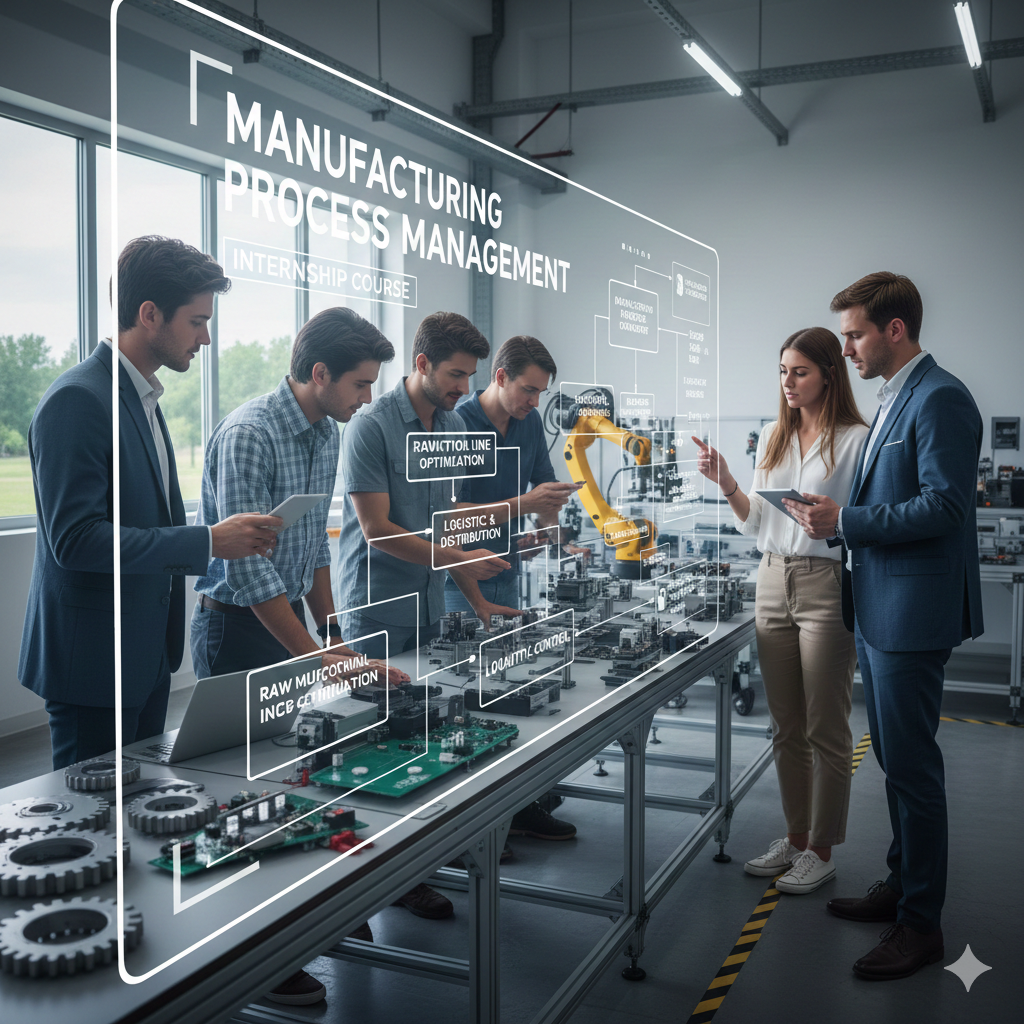
This internship course is designed to bridge the gap between theoretical mechanical design and large-scale industrial production. Students will explore how to transform raw designs into finished products by optimizing resources, managing workflows, and implementing cutting-edge manufacturing technologies.

You will move beyond the “how to build” and focus on the “how to build efficiently” using Industry 4.0 principles.


What You Will Learn

  • Production Planning & Control: Mastering the scheduling of machines, labor, and materials to ensure seamless output.

  • CAD/CAM Integration: Bridging the gap between 3D modeling and automated manufacturing through computer-aided manufacturing.

  • Quality Management Systems (QMS): Implementing Lean Six Sigma and Total Quality Management (TQM) to minimize defects.

  • Automation & Robotics: Understanding the role of PLC programming and robotic arms in high-volume production lines.

  • Supply Chain & Logistics: Managing the flow of raw materials and finished goods in a globalized manufacturing environment.


Core Learning Pillars

Pillar Focus Area Key Outcome
Process Design Workflow Mapping Reducing bottlenecks in production.
Resource Allocation ERP Systems Optimizing the use of materials and human capital.
Sustainability Green Manufacturing Reducing carbon footprints and industrial waste.
Digital Twin Simulation Testing production lines in a virtual environment before physical setup.

Why Enroll in This Internship?

  1. Hands-on Experience: Work with real-world industrial data and simulation software.

  2. Industry 4.0 Ready: Gain exposure to IoT-enabled factories and smart manufacturing.

  3. Career Readiness: Develop the skills required for roles such as Process Engineer, Production Manager, or Operations Analyst.

“The goal of Manufacturing Process Management isn’t just to make things—it’s to define the most efficient path from an idea to a reality.”

Show More

What Will You Learn?

  • Production Planning & Control: Mastering the scheduling of machines, labor, and materials to ensure seamless output.
  • CAD/CAM Integration: Bridging the gap between 3D modeling and automated manufacturing through computer-aided manufacturing.
  • Quality Management Systems (QMS): Implementing Lean Six Sigma and Total Quality Management (TQM) to minimize defects.
  • Automation & Robotics: Understanding the role of PLC programming and robotic arms in high-volume production lines.
  • Supply Chain & Logistics: Managing the flow of raw materials and finished goods in a globalized manufacturing environment.

Course Content

Week 1: Foundations of MPM & Product Lifecycle
- Chapter 1: Introduction to MPM vs. Traditional Manufacturing. - Chapter 2: The Digital Thread: Linking CAD (Design) to CAM (Manufacturing). Activity: Analyzing a product’s Bill of Materials (BOM) and Bill of Process (BOP).

Week 2: Materials & Primary Transformation
- Chapter 3: Advanced Engineering Materials (Alloys, Composites, Polymers). - Chapter 4: Primary Processes: Casting, Forging, and Molding optimization. Activity: Material selection case study based on stress requirements and cost.

Week 3: Subtractive & Additive Manufacturing
- Chapter 5: CNC Machining: Toolpath optimization and G-Code logic. - Chapter 6: Industrial 3D Printing: Scaling additive manufacturing for production. Activity: Designing a part for "Design for Manufacturing" (DFM) to reduce machining time.

Week 4: Automation & Industry 4.0
- Chapter 7: Robotics in Manufacturing: End-of-arm tooling and kinematics. - Chapter 8: Sensors & The Industrial Internet of Things (IIoT). Activity: Simulating a robotic assembly cell workflow.

Week 5: Quality Control & Metrology
- Chapter 9: Statistical Process Control (SPC) and Tolerance Analysis. - Chapter 10: Non-Destructive Testing (NDT) and CMM Inspection. Activity: Performing a Root Cause Analysis (RCA) on a failed batch of components.

Week 6: Lean Manufacturing & Process Optimization
- Chapter 11: Lean Tools: 5S, Kaizen, and Value Stream Mapping (VSM). - Chapter 12: Identifying and eliminating the "8 Wastes" in a production line. Activity: Creating a Value Stream Map for a mock assembly line to identify bottlenecks.

Week 7: Production Planning & ERP Systems
- Chapter 13: Enterprise Resource Planning (ERP) and Shop Floor Control. - Chapter 14: Just-In-Time (JIT) vs. Just-In-Case (JIC) inventory management. Activity: Using a spreadsheet or software to balance a multi-station production line.

Week 8: Sustainable Manufacturing & Capstone
- Chapter 15: Circular Economy: Recycling and Energy Efficiency in Factories. - Chapter 16: Final Project: Designing a complete "Factory Layout" for a specific product. Activity: Final Presentation of the 8-week internship project.

Final Assessment / Course Completion Test
2 Weeks / 4 Weeks / 6 Weeks / 8 Weeks internship period student can directly jump for final assessment after instructor command with your activation code.

Student Ratings & Reviews

No Review Yet
No Review Yet